
On Belief and Conspiracies

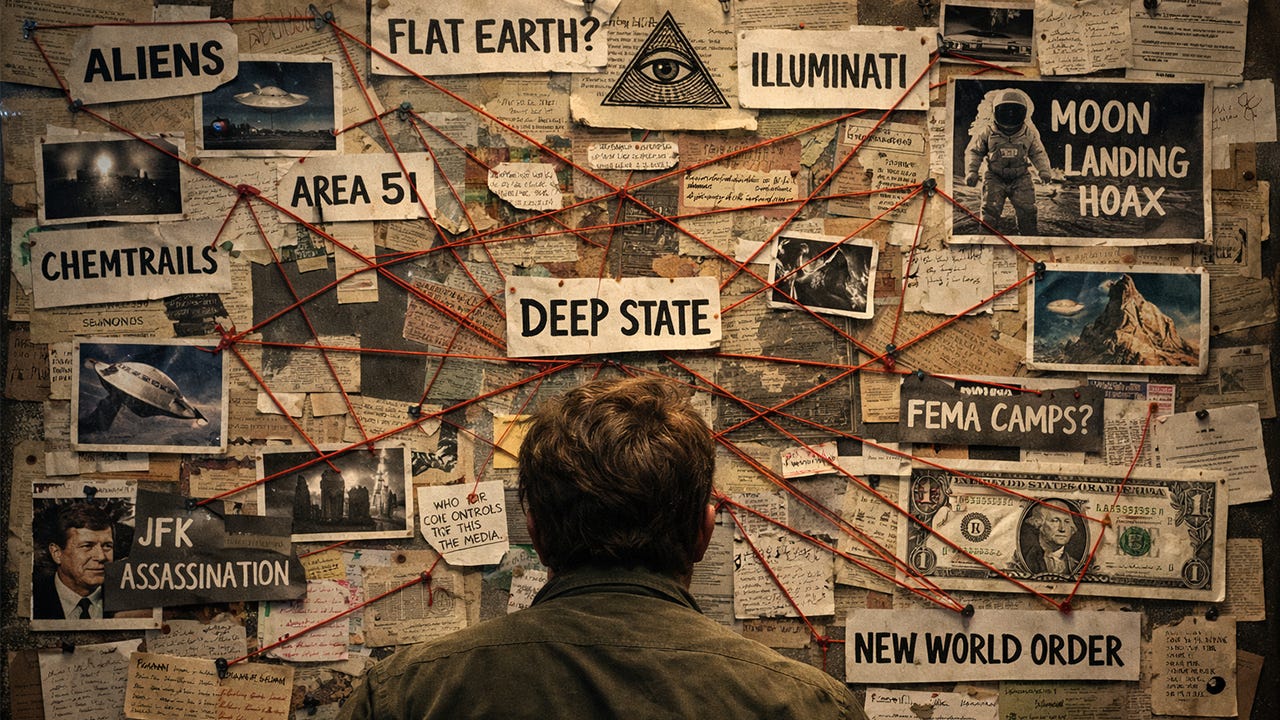
I want to address the recent explosion of conspiracy theories, especially those that are demonstrably false—claims we can now show, beyond reasonable doubt, are untrue. Before addressing specific examples, I want to say something fundamental about belief itself.
Belief is not something we consciously choose. We are either convinced of something or we are not. That’s it. This is why it is extremely counterproductive to degrade, attack, shame, or blacklist people for holding different beliefs. When we do that, we implicitly assume they chose those beliefs. But the truth is, we didn’t choose our own beliefs either. We oppose certain beliefs because we are convinced they are false, not because we freely selected one option from a menu of beliefs.
In every case, people believe what they believe because of the information they have been exposed to. Those who hold false beliefs—such as Flat Earth or the moon landing hoax—are not exposed to the information that would convince them otherwise. It really is that simple. They did not choose to believe Earth is flat or that we never went to the moon; they are convinced of those claims based on what they’ve seen and been told.
This is why shaming people for holding preposterous beliefs is ineffective. They lack the information necessary to see the flaws in their worldview. Attacking them does nothing to correct that—it only deepens the divide. But we now all live in a tribal, debatebro enviroment, which is not about the love of widsom (philosophy) but the love of winning (eristics).
Through studying epistemology, I learned about coherentism, an epistemological view that claims beliefs are justified if they cohere with one another. Think of belief as a web: each belief supports the others. This is exactly how conspiracy theories operate. A person’s entire worldview can be internally coherent while still failing to correspond to reality.
For example, someone can hold a religious worldview that coheres perfectly with its doctrines, personal experiences, and teachings—yet there is no way to step outside one’s own perspective and directly verify whether those beliefs correspond to the external world. The same applies to conspiracy theories. A Flat Earther cannot leave their body and go into space to see the Earth’s shape for themselves. They must rely on testimony, evidence, institutions, and authorities.
The problem is that conspiracy theorists don’t trust those sources. They believe governments and institutions are lying to them. Now, to be fair, governments and institutions have lied—and still do. But the fact that authorities sometimes lie does not mean they are always lying. Once a person’s beliefs cohere within their worldview, they stop testing them against the outside world.
I am not denying that there are conspiracies out there; infact, many conspiracies have turned out to be true, in both business and politics. I subscribe to many conspiracy theories where the circumstantial evidence leans heavily toward what seems to be true. Yet even these have not been proven to be true with 100% certainty, but are most likely to be the true because the official narrative has so many holes in it.
But in the cases where they are demonstrable false on an empirical level, are results of people’s compete ignorance on certain topics. In many cases, people who fall into conspiracy theories regarding the sciences, never learned the official explanations to begin with. Most Flat Earthers don’t actually understand how the globe model works. People who believe the moon landing was faked don’t know how we got to the moon in the first place. Their first exposure to these topics came from conspiracy theorists feeding them misinformation. In other words, people who actully know how we got to the moon don’t suddenly become moon landing deniers, and people who learned how the globe model works don’t suddenly abandon it because the official FE model (which doesn’t exist) has more explanitory power (it has none).
The problem isn’t that questioning authority is irrational. The problem is that the alternative explanations don’t add up. They defy physics, mechanics, and everything else we know about reality. In both cases—the shape of the Earth and the moon landings—we can demonstrate beyond any reasonable doubt that the Earth is a sphere and that humans have been to the moon multiple times.
I predicted last year that the JQ Movement, if not checked, would become infected with all sorts of these demonstrablly false conspiracies, thanks to the astroturfing of shady figures—who came out of nowhere—taking the helm and leading eveyrone astray. Once these charlatans took control, it was only a matter of time until our cause would be destroyed.
But how?
Simple: these belief systems infect people’s minds by creating bubbles of internal coherence. Inside these bubbles, everything seems to make sense. Outside these bubbles, the beliefs collapse because they fail to explain reality as a whole. However, these clever charaltans also create a cult-like following, so its members never check their beliefs against reality necause a.) they don’t want to abandon their new tribe, and b.) they don’t want to admit they were duped.
Take Flat Earth again: its proponents attempt to debunk isolated facts one at a time, but they have no comprehensive model. There is no Flat Earth model that explains all the phenomena the globe model explains. Yet they insist that anyone who disagrees is a shill, a moron, or an idiot. The same pattern appears with moon landing denial.
The truth is, these people are not stupid, but they are very lazy and stubborn. This combination is extremely difficult to deal with, since any information you do give them, they won’t even both to check. Most of the time they assume you haven’t seen their side of the story, and they have something you must see. But the fact is, many of us have seen their side, which is why we know it’s false.
I believe those of us who know the facts have a responsibility to give them accurate information, not to attack them. Whether they accept that information is another matter entirely. People rarely change their beliefs on the spot because doing so requires dismantling an entire web of beliefs, one strand at a time.
That’s why I don’t argue with people about these things. I give them the information and walk away. Over time, it may click, or it may not. But attacking them only reinforces their sense that they possess secret knowledge and that everyone else is deluded. It strengthens their defenses and traps them deeper inside their worldview.
If we want people to wake up, we must stop reinforcing the very mechanisms that keep them asleep. Our job is to offer the truth calmly and respectfully, then step away. Anything else only pushes them further into the box we claim we want them to escape.
This is why I have decided that this year I must change my approach entirely, both with allies and with opponents. I am abandoning the once-effective but now counterproductive denigrating “drill-instructor” approach, which served its purpose during the Gaza genocide by motivating people to overcome their fear of certain ideas and buzzwords. That phase is over. What is needed now is a stoic sage—someone unaffected by insults or emotional outbursts—who can patiently guide people back to reality.
If we want to heal the sick and the deluded, we must learn to see them as patients in need of care, not enemies to be crushed.
What kind of doctor seeks to further harm their patients?
A good doctor is patient with his patients.
Who the hell are you to say what's false or not, good grief, get over yourself!
I've been following and admiring your work for a while now, was very impressed with your spirit, your ideas, and your ability to inspire and your ability to speak.
However, I agree with much of Res Cogitans' comment in this thread (although I still give you the benefit of the doubt). Furthermore I think you are projecting onto your readers that which applies to yourself, especially with regards to the moon landing topic. Your article is somewhat patronizing and disappointing.